InsightEmb: Learning Action-Intent Embeddings for Agentic Insight Retrieval

1The Hong Kong University of Science and Technology
2WeChat AI, Tencent
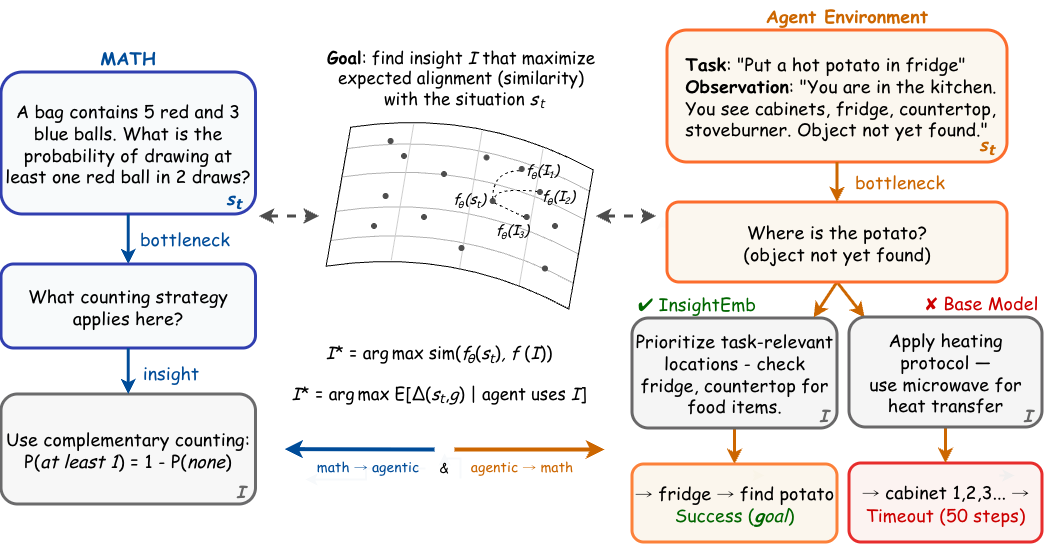
InsightEmb overview: shared situation-to-insight structure between math and agentic tasks

The same situation → bottleneck → rule structure appears in math reasoning and agentic execution. InsightEmb learns this shared geometry from math data alone, then retrieves the bottleneck-resolving rule for agent states.

TL;DR

Retrieving the right strategic insight at each step is critical for LLM agents, but standard retrievers match semantic similarity, not what unblocks progress. InsightEmb is a contrastive embedding model trained only on math reasoning data that learns progress-oriented, action-intent matching — and it transfers zero-shot to ALFWorld, WebShop, and ScienceWorld, beating the base embedder and reasoning-oriented retrievers.

Abstract

Self-improving agents accumulate reusable insights from prior trajectories, making retrieval increasingly important for turning accumulated experience into actionable guidance. At each decision step, retrieving the right insight can help the agent progress toward its goal, a setting we refer to as agentic insight retrieval. However, existing retrieval methods primarily model semantic similarity, while overlooking whether a retrieved insight resolves the agent's current decision bottleneck. We propose InsightEmb, a contrastive embedding framework that learns transferable progress-oriented retrieval geometry using only mathematical reasoning data. InsightEmb jointly learns to align concrete situations with abstract heuristic rules and to cluster reasoning trajectories with similar progress structures. We evaluate InsightEmb on dynamic agent tasks and a static skill-retrieval benchmark. Without any environment-specific training, InsightEmb improves over all these evaluations, surpassing the performance of existing reasoning embedding models. These results suggest that the geometry of state-insight matching can transfer across domains, enabling effective training from publicly available reasoning data without expensive environment-specific supervision.

Contributions

  • Formulation. We frame agentic insight retrieval as goal-conditioned action-intent matching: relevance is whether an insight resolves the current bottleneck and enables progress, not semantic similarity alone.
  • Method. We introduce InsightEmb, a cross-domain contrastive framework for action-oriented retrieval geometry, trained entirely on publicly available math reasoning data.
  • Evidence. Across dynamic (ALFWorld, WebShop, ScienceWorld) and static (SRA-Bench) evaluations, InsightEmb improves over the base embedder with fewer steps; analyses confirm the gains come from action-intended retrieval.
+72%
relative on WebShop Bundle vs Base
+8.90
R@10 gain on SRA-Bench
math-only
training data source

Method

Our key observation is that the situation-to-insight matching problem is not domain-specific. A math query (matching "P(at least one red)" to complementary counting, with no lexical overlap) and an embodied task (first resolving the locate-object bottleneck before heating or placement insights apply) both require inferring the latent bottleneck of a concrete situation and retrieving the abstract rule that enables the next effective step. InsightEmb exploits this shared structure with a two-stage contrastive curriculum.

Stage 1

Situation-to-Insight Matching

Bridges the abstraction gap by mapping math problems and (partial) chain-of-thought trajectories to their relevant heuristic rules, so the model learns to connect a concrete situation to the abstract rule that resolves its current bottleneck.

Stage 2

Situation-to-Experience Matching

Teaches structural similarity recognition between reasoning trajectories, reinforcing the model's ability to identify when two different-looking situations require the same underlying strategy.

At inference time the trained model retrieves insights for LLM agents in ALFWorld, WebShop, and ScienceWorld, with SRA-Bench as a static skill-retrieval diagnostic.

Dynamic Agent Evaluation

InsightEmb is trained only on math reasoning data, so every gain below is entirely from cross-domain transfer. It outperforms the base embedder on all three environments under both insight corpora (Bundle and Atomic), with top-1 dynamic retrieval and a Qwen3-8B agent.

Insight Embedding ALFWorld WebShop ScienceWorld
{} (no insight) 52.8631.032.40
BundleBase 54.2918.427.40
BundleInsightEmb 60.7131.748.00
AtomicBase 55.0028.257.40
AtomicInsightEmb 59.2932.0510.20

Test success rate (%) for ALFWorld / ScienceWorld and average task score (%) for WebShop.

On WebShop, a progress-blind retriever can be worse than no retrieval at all (Base Bundle 18.42% vs. 31.03% no-retrieval): it surfaces premature or topically-related but procedurally irrelevant insights from a largely unhelpful pool. InsightEmb filters such insights, turning a net-harmful retrieval setting into a net-useful one (31.74%).

Scaling vs. Reasoning-Oriented Retrievers

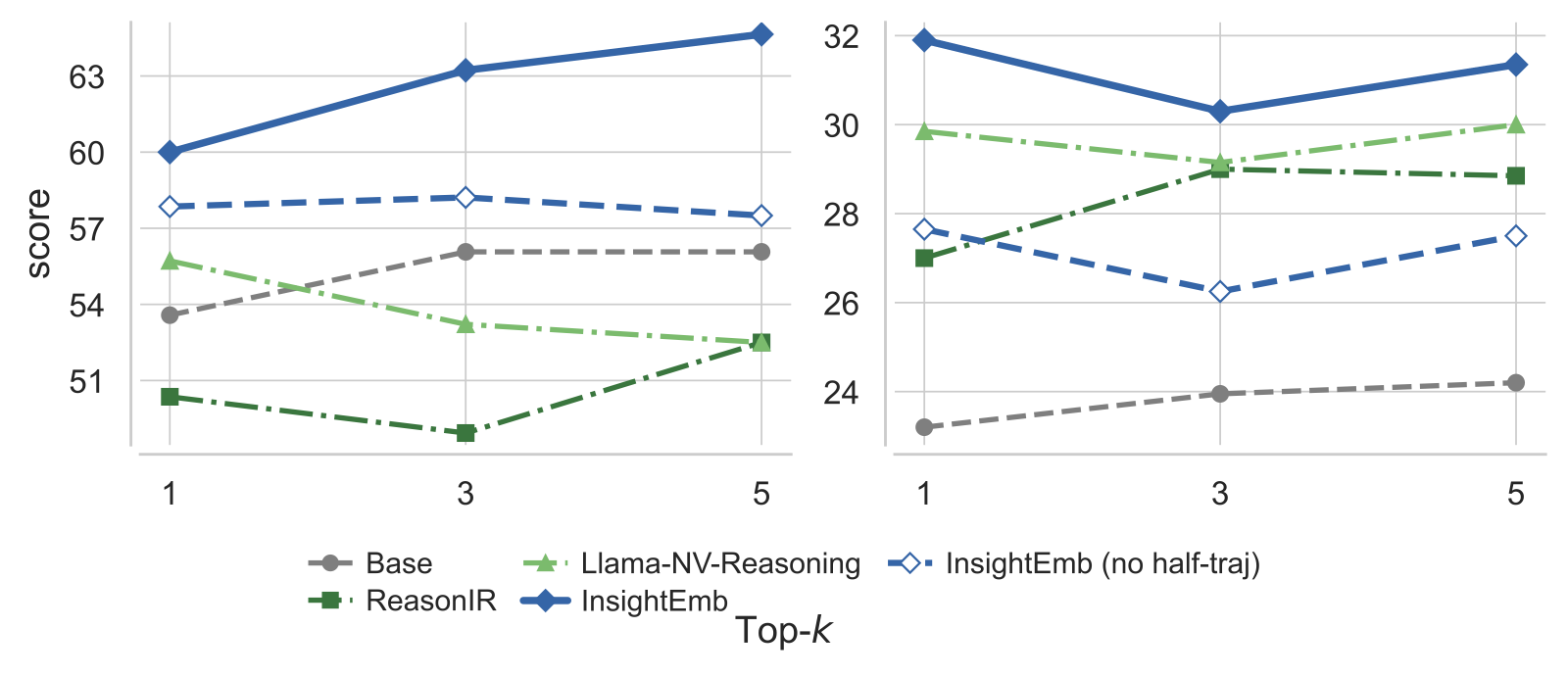
Reasoning-oriented retrievers are trained for static query–document matching, whereas agentic insight retrieval needs dynamic action-intent matching against an evolving state. Across retrieval budgets k ∈ {1, 3, 5}, InsightEmb (solid blue) surpasses ReasonIR and Llama-NV-Reasoning on both ALFWorld and WebShop. The dashed curve is the no half-traj ablation, which removes partial-trajectory queries from Stage 1.

Top-k scaling vs reasoning-oriented retrievers on ALFWorld and WebShop

Top-k scaling (corpus-averaged). Left: ALFWorld success rate. Right: WebShop average task score.

Static Skill Retrieval (SRA-Bench)

On static task-to-skill matching, InsightEmb improves over the base embedder at every cutoff, with small gains at R@1 and substantially larger gains at higher cutoffs (+8.90 R@10).

Embedding R@1R@3R@5R@10 N@1N@10
Base 30.3340.8446.4054.13 33.8242.64
InsightEmb 31.3746.3954.2563.03 36.2948.42
Δ +1.04+5.55+7.85+8.90 +2.47+5.78

Macro-average recall (R@k) and nDCG (N@k) across six task families. N@5/N@7 omitted for brevity.

Qualitative Example

WebShop task: find a button-tufted, mid-century dining set with solid wood, a light-grey variant, and a price below $250. The key bottleneck is not general product relevance. It is executing the complete search-to-purchase sequence without entering a refinement loop. The Base-side insight below is an illustrative reconstruction of the progress-blind guidance implied by the observed 50-step behavior, rather than a verbatim quotation.

Base Model

Representative Base-style insight: "Exhaustive Search Refinement: if the current results do not satisfy every constraint, keep refining the query and browsing additional result pages until an exact match appears."

Search → back to search → re-search → paginate → back to search → repeat.

The insight emphasizes continued refinement but provides no stopping rule, commitment criterion, or recovery action. The agent therefore remains in a search-refine-next-back loop and never commits to a product.

→ Lost after 50 steps, score 0.000

InsightEmb

"Precision-First Search: include all critical attributes, including type, color, size, and price limit, in the initial query."

Comprehensive search → click product → select light grey → buy now.

→ Won in 4 steps, score 1.000

Robustness & Takeaway

The gains are consistent across environment, action model (Qwen3-8B and GPT-5.2), insight source (DeepSeek-R1, GPT-5.2, prebuilt skills), corpus granularity, and retrieval budget. InsightEmb also exceeds an ALFWorld-trained in-domain retriever despite using no ALFWorld data, and transfer is bidirectional: an ALFWorld-trained model improves math insight retrieval too.

Together, these results support a simple design claim: math heuristic retrieval and agentic insight retrieval share the same progress-oriented matching structure, so a model can learn it from public reasoning data without expensive environment-specific supervision.
Citation

@article{chung2026insightemb,
  title     = {InsightEmb: Learning Action-Intent Embeddings for Agentic Insight Retrieval},
  author    = {Chung, Tsz Ting and Li, Jiangnan and Zhou, Jie and Yu, Mo},
  journal   = {arXiv preprint},
  year      = {2026}
}